A transmission rarely dies without warning. Most of the time it complains first: a late shift, a flare in rpm, a clunk into reverse, a smell you can't place. The hard part isn't spotting that something is wrong. It's figuring out whether you're looking at a $150 fix or a whole replacement, and which option makes sense for the car you actually own.
This guide walks through the most common signs of a bad transmission, what each one usually points to, how to narrow it down before you spend money, and how to decide between a repair, a rebuild, a remanufactured unit or a used transmission.
Quick answer
The classic signs of a bad transmission are slipping, delayed engagement, harsh or erratic shifts, noises that change with gear or speed, a burning smell, leaks, and a warning light or limp mode. Some of these come from cheap outside parts like fluid level, a sensor, a solenoid or a wiring connector. Others mean the clutches, bands, pump or torque converter inside are worn out.
As a rough rule:
- One symptom, clean fluid, a specific code often means a repair.
- Several symptoms, burnt fluid, heavy debris, no drive or no reverse usually means rebuild or replace.
- Replacement wins when internal repair costs approach the price of a good replacement unit, or when the car is worth keeping but a rebuild would take too long.
Common signs of a bad transmission
Slipping
You press the gas, the engine revs climb, but the car doesn't speed up the way it should. Sometimes it feels like a brief neutral between gears. In an automatic, slipping usually means the clutch packs or bands can't hold, often because of low fluid, low line pressure or plain wear. In a manual, it's more often the clutch itself than the gearbox.
Delayed engagement
You shift into Drive or Reverse and wait a second or two before it catches, sometimes with a thump. A short delay on a cold morning that goes away once warm can be fluid-related. A long delay that's getting worse points to internal leakage, a weak pump or worn seals.
Harsh, late or erratic shifts
Bangs into gear, shifts that come way too late, or a transmission that hunts between gears. Modern automatics are controlled by a computer, so this can be electrical (a sensor, solenoid or module issue) or mechanical (worn valve body bores, worn clutches). This is the symptom where a scan tool earns its keep.
Strange noises
- Whine or hum that changes with speed: can be a pump, bearings, or low fluid.
- Clunk when shifting into gear: check mounts, U-joints and CV axles first. A worn transmission mount mimics internal problems surprisingly well.
- Grinding in a manual when shifting: usually worn synchros or a clutch that isn't fully releasing.
- Buzzing or rattling in neutral that changes with engine rpm: sometimes a torque converter or flexplate issue.
Burning smell and dark fluid
A burnt, sharp smell usually means fluid has overheated or is leaking onto the exhaust. Healthy automatic transmission fluid is typically red or pinkish and clear (some newer fluids are a different color, so check your owner's manual). Brown or black fluid that smells burnt means heat has broken it down, and often that friction material is already wearing.
Leaks
Red or brown drips toward the middle or front of the car. Common sources are the pan gasket, cooler lines, axle seals and the front pump seal. A leak by itself is usually repairable. The danger is driving on low fluid until the leak causes the internal damage.
Warning light, codes or limp mode
Many vehicles store transmission codes and switch to a fail-safe "limp" mode stuck in one gear to protect the unit. That's annoying, but it's also useful: the codes tell your shop where to start looking.
CVT-specific signs
Continuously variable transmissions (common in many Nissan, Subaru, Honda and Toyota models) don't shift in steps, so the signs look different: a droning or whining that rises with speed, a shudder or judder from a stop, a "rubber band" feel with high rpm and slow acceleration, or sudden loss of power with a warning light. If you drive something like a Nissan Altima, these are the symptoms to watch for.
What each symptom usually points to
This table is a starting point for a conversation with your mechanic, not a diagnosis. The same symptom can have very different causes on different vehicles.
| Symptom | Often an outside or cheaper fix | Often an internal problem |
|---|---|---|
| Slipping | Low fluid, wrong fluid | Worn clutches or bands, low pump pressure |
| Delayed engagement | Low or cold fluid, clogged filter | Worn seals, weak pump, valve body wear |
| Harsh or erratic shifts | Sensor, solenoid, wiring, software | Worn valve body, worn clutch packs |
| Clunk into gear | Mounts, U-joints, CV axles | Excess internal play |
| Whine or hum | Low fluid | Pump, bearings, planetary gears |
| Burning smell | Leak onto exhaust, towing heat | Overheated, glazed friction material |
| No drive or no reverse | Shift cable or linkage | Failed clutch pack, broken internal part |
| Warning light or limp mode | Sensor, connector, module | Internal slip detected by the computer |
How to narrow it down before you spend money
You don't need a lift to do the first few checks. Before you approve a big quote, go through these in order.
- Check the fluid, if you can. Many older vehicles have a dipstick. Check level and condition following the procedure in your owner's manual (some must be checked hot, in park, engine running). Many newer transmissions have no dipstick and need a shop to check level properly.
- Scan for codes. A basic OBD2 scanner reads generic codes, but transmission-specific codes often need a better scan tool. Write down every code and whether it's current or history.
- Look for leaks and outside damage. Wet spots around the pan, cooler lines, axle seals and the bell housing. Look at the transmission mounts while someone gently shifts between Drive and Reverse with the brake held.
- Check for open recalls and bulletins. Enter your VIN at NHTSA's recall lookup. Some known transmission problems have software updates or extended coverage from the automaker.
- Ask for a written diagnosis. A good transmission shop will road test, scan, check line pressure if needed, and, for internal problems, look at the pan for debris. Ask exactly what they found and what each part of the quote is for.
Be careful with a few common "fixes." A full fluid flush on a high-mileage unit with old, dark fluid is a debated move, and many shops prefer a pan drop and filter service instead. Bottled additives might mask a symptom for a while, but they don't rebuild worn clutches. If your shop suggests a fluid service, ask them why and what the risks are for your specific transmission.
Repair vs rebuild vs replace: what each option means
Once you know what's wrong, there are four main paths.
Repair
Fixing one specific problem without opening the whole unit: a leaking seal, a speed sensor, a shift solenoid, a valve body, a mount, a software update. This is the cheapest path and the right one when the internal hard parts are healthy.
Rebuild
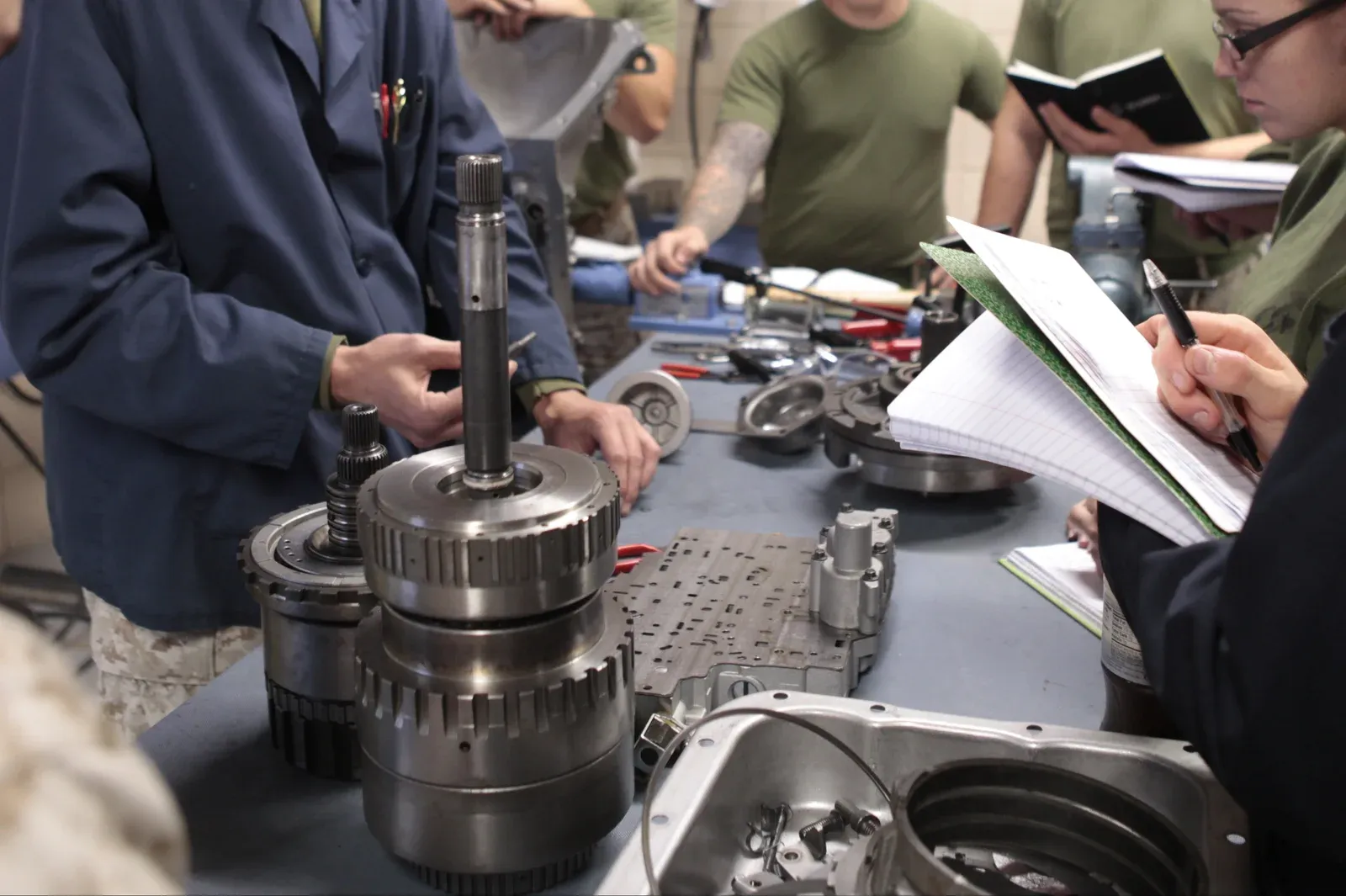
The transmission is removed, taken apart, cleaned and inspected. Worn soft parts (clutches, seals, gaskets, filter) are replaced, plus any hard parts that are damaged. Quality depends heavily on the shop, and downtime is often longer because the shop has to disassemble, wait for parts and reassemble.
Remanufactured unit
Rebuilt in a factory-style process to a set specification, usually with updated parts that fix known weaknesses, and normally sold with a strong warranty. Typically the most expensive replacement option. If you want the terminology explained in more depth, our guide to used vs rebuilt vs remanufactured covers the same labels as they apply to engines.
Used (salvage) transmission
A working original-equipment unit taken from a donor vehicle, often with known mileage. It's usually the lowest-cost way to get a complete, factory-built transmission back in the car, and it can be installed quickly because the unit already exists. The key is buying an exact match, from a seller who tests and warrants it.
How to decide: a simple framework
There is no single correct answer, but these questions sort out most cases.
1. Is the damage internal?
If the problem is outside the case (a sensor, solenoid, wiring, mount, leak or software), repair it. If the shop finds burnt friction material, heavy metal in the pan, broken parts, or the unit won't move in one or more gears, you're likely in rebuild-or-replace territory.
2. How does the repair cost compare to replacement?
Automakers use cost thresholds too. For example, a Volkswagen technical bulletin for one of its automatic transmissions, published on NHTSA's site, tells technicians to replace rather than repair when internal repair parts and labor reach more than 80% of the cost of a replacement unit. That's one manufacturer's rule for one transmission, but the logic works for anyone: when the repair estimate gets close to the cost of a replacement, replacement usually gives you more for your money.
3. What is the car worth to you?
Compare the total job cost against what the car is worth and what replacing the car would cost. Then add any other repairs it needs soon. A solid truck with a healthy engine and clean body is often worth a transmission. A car that also needs tires, brakes, a timing job and suspension may not be.
4. How long can you be without the car?
A shop rebuild can take time. A used or remanufactured unit can often be installed as soon as it arrives. If the vehicle is your work truck, downtime may matter as much as price.
5. How long do you plan to keep it?
If you plan to keep the car for years, a well-documented used unit with a long warranty or a remanufactured unit make sense. If you plan to sell soon, a simple repair or a modest used unit is often enough.
A quick summary
| Situation | Usually the better choice |
|---|---|
| Outside part failed, fluid clean, no debris | Repair |
| Internal wear, trusted local rebuilder, time isn't critical | Rebuild |
| Internal failure, car worth keeping, want fastest install at lower cost | Used transmission |
| Internal failure, keeping the car long term, budget allows | Remanufactured |
| Repair cost near or above the car's value | Consider replacing the vehicle |
If you go with a used transmission
A used unit can be a smart move, but only if it's the right one. Here's what matters most.
- Match it exactly. Same transmission model, drive type (2WD, 4WD or AWD), and for many vehicles the same engine size. Trucks like the Ford F-150 have used several different automatics over the years, so year alone isn't enough. Use your VIN and, where possible, the transmission tag or option code. Our guide on how to check a used transmission before you buy covers matching in detail.
- Look at mileage and grade. Listings that show donor mileage and condition help you compare. For example, this 2021 Nissan Altima 2.0L used transmission and this 2023 Ford F-150 3.3L used transmission both list mileage and grade on the page.
- Plan for programming. Many modern transmissions need software setup or a relearn after install. Read does a used transmission need to be programmed before you book the shop.
- Fix the cause of the old failure. If the old unit died from overheating, replace or flush the cooler and lines. Metal debris left in a cooler can find its way into the replacement.
- Read the warranty terms first. State Auto Parts' 2-year warranty covers the transmission case and its internal parts, but not labor, sensors or wiring. It also requires installation by a qualified technician within ten business days of delivery and proper fluid maintenance. Don't take the unit apart, since disassembled parts aren't covered.
- Know the shipping and return rules. Check the shipping policy for delivery details and the refund and return policy before you order, and inspect the unit for freight damage before you sign for it.
Popular models are a good place to start browsing, such as used transmissions for the Chevy Equinox, Toyota RAV4, Nissan Altima and Ford F-150, or the full used transmissions catalog.
Mistakes that turn a repair into a replacement
- Driving on a slipping transmission. Every slip creates heat and wears friction material. A unit that might have needed a seal or solenoid can be ruined in a few hundred miles.
- Ignoring a leak. Low fluid is one of the most common causes of transmission damage, and it's one of the easiest to prevent.
- Topping off with the wrong fluid. Many transmissions need a specific fluid. The wrong one can change shift feel and wear the clutches faster.
- Towing over the limit. Heat is the enemy. If you tow often, ask your mechanic whether an auxiliary cooler makes sense.
- Approving a big job without a clear diagnosis. If the quote says "rebuild" but no one has scanned the codes or looked at the pan, get a second opinion.
Bottom line
Signs of a bad transmission are worth taking seriously, but they don't always mean the transmission is done. Check fluid, scan codes, look for leaks and mount problems, and get a written diagnosis. If the damage is internal and the repair estimate gets close to the price of a replacement, a correctly matched used transmission with a solid warranty is often the most practical way to get the car back on the road.