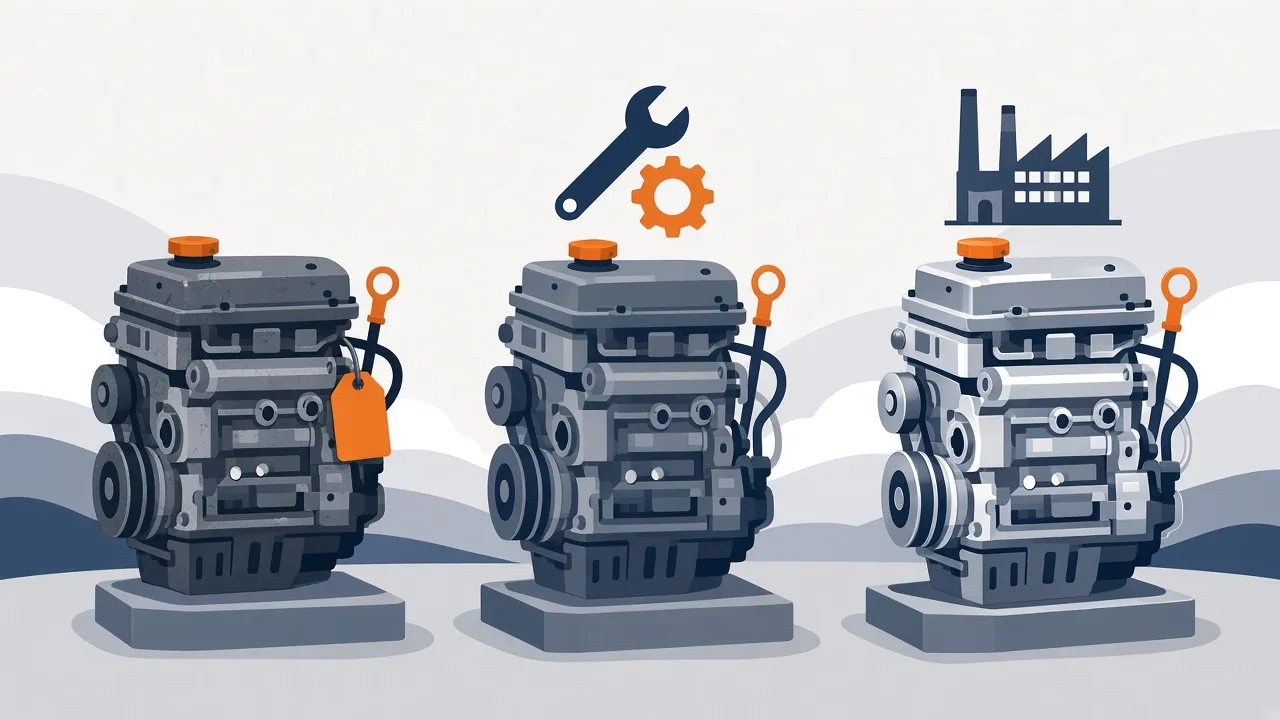
Your engine is done. Maybe it spun a bearing, maybe it overheated once too often, or maybe the shop quote to repair it came back higher than you expected. Now you are looking at three words that sound almost interchangeable: used, rebuilt and remanufactured.
They are not interchangeable. Each one describes a different amount of work done to the engine, and that difference shows up in price, in what kind of warranty you can expect, and in how much risk you carry after it is bolted in. This guide explains what each term actually means (including how the U.S. Federal Trade Commission defines them), where each option makes sense, and the questions to ask before you pay for any of them.
The short answer
- Used engine: a complete engine taken from a donor vehicle and sold without being torn down and rebuilt. Usually the lowest cost and the fastest to get. Its condition depends on the donor's mileage, maintenance history and how well it was tested.
- Rebuilt engine: an engine that has been taken apart, cleaned, and had its worn or damaged parts repaired or replaced. Quality depends a lot on who did the work.
- Remanufactured engine: rebuilt to the same standard, but at a factory that is generally in the business of rebuilding engines. Usually the most expensive of the three and often the hardest to get quickly for less common vehicles.
None of these is automatically "best." A good low-mileage used engine can be a smarter buy than a poorly done rebuild, and a remanufactured engine can be overkill on a high-mileage car you only plan to keep for two more years.
What the terms legally mean in the U.S.
A lot of sellers use these words loosely, so it helps to know that the FTC has published guidance on them. The FTC's Guides for the Rebuilt, Reconditioned, and Other Used Automobile Parts Industry (16 CFR Part 20) cover engines and transmissions specifically. In plain English:
- Not-new parts must be disclosed as not new. The guides say it is deceptive to represent a part as new when it isn't, or to misrepresent its condition or how much it has been used. Terms the FTC lists as appropriate disclosures include "Used," "Secondhand," "Rebuilt" and "Remanufactured."
- "Rebuilt" has a meaning. Under the guides, a part should only be called rebuilt if, since it was last used, it has been dismantled and reconstructed as necessary, all internal and external parts cleaned and made rust and corrosion free, all impaired, defective or substantially worn parts restored to sound condition or replaced, missing parts replaced, and machining done as needed to put it in sound working condition.
- "Remanufactured" or "factory rebuilt" adds one requirement: the rebuild described above has to be done at a factory generally engaged in rebuilding those products.
So the legal difference between rebuilt and remanufactured is less about which parts get replaced and more about where the work is done. In practice, remanufacturers tend to run standardized processes on every unit, while rebuild quality ranges from excellent machine-shop work to a quick reseal and re-ring.
A used engine, on the other hand, has not gone through that teardown. It is the engine as it came out of the donor vehicle, ideally cleaned up, inspected and tested.
Side-by-side comparison
| Used engine | Rebuilt engine | Remanufactured engine | |
|---|---|---|---|
| What was done | Removed from a donor vehicle, inspected and (ideally) tested | Disassembled; worn or damaged parts repaired or replaced | Rebuilt to the same standard at a factory that rebuilds engines |
| Internal wear | Whatever the donor accumulated | Depends on what the builder replaced | Wear parts renewed as part of a standardized process |
| Consistency | Varies unit to unit | Varies builder to builder | Most consistent of the three |
| Relative cost | Usually lowest | Middle | Usually highest |
| Availability | Good for common vehicles, including newer models | Depends on local shops and cores | Strong for popular engines, thinner for rare ones |
| Lead time | Often ships from stock | Can take days or weeks if your own engine is rebuilt | Varies; some units are built to order |
| Warranty | Varies widely by seller, from none to multi-year | Varies widely by builder | Typically the longest terms |
| Best fit | Budget repairs, newer vehicles with low-mileage donors available, getting back on the road fast | Older or specialty engines, or when you trust a specific shop | Long-term ownership and maximum peace of mind |
Prices and warranty terms vary a lot by engine, seller and market, so treat the "relative cost" row as a general pattern, not a quote. Always compare the actual written terms.
When a used engine makes the most sense
A used engine is often the right call when:
- The vehicle is fairly new and low-mileage donors exist. Modern vehicles that were totaled in collisions often have engines with relatively few miles on them. For newer trucks and cars, a used OEM engine can have less wear on it than you'd expect from the word "used."
- You need the vehicle back quickly. A used engine can usually ship right away instead of waiting on machine work.
- The total repair has to make financial sense. On a vehicle worth a few thousand dollars, the lower part cost of a used engine is often what makes the repair worth doing at all.
- You want the original factory engine your vehicle was built with.
For example, on the State Auto Parts site you can browse used Ford F-150 engines, used Chevy Silverado 1500 engines, used Toyota Camry engines and used Honda Accord engines. Listings show the year, engine option (displacement and VIN code), an approximate mileage range and a part grade, which are the details you need to compare units. A listing like this 2023 Ford F-150 3.5L turbo engine (VIN code 8) shows how specific the match needs to be: the same model can be built with several different engines, and the VIN code tells you which one you have.
The risks with used engines
- Unknown history. You usually don't know exactly how the donor was maintained.
- Mileage is an estimate. Many sellers say so in writing. State Auto Parts' return policy and warranty, for example, both say mileage is not guaranteed and is stated to the best of their knowledge.
- Wear items are on you. Seals, gaskets, sensors, hoses and other bolt-ons on a used engine are usually not covered. Plan to replace common wear items before installation.
None of these are deal-breakers, just reasons to ask good questions. See our guides on what to look for when buying a used engine and how many miles is good for a used engine.
When a rebuilt engine makes the most sense
A rebuild is worth a look when:
- Your engine is rare or hard to source. Older, low-volume or specialty engines may have few clean used units available.
- Your original block is worth saving. Matching-numbers classics or engines with a documented history are common examples.
- You have a shop you trust. Because rebuild quality depends on the builder, a good local machine shop with a clear warranty is the deciding factor.
The main risk is inconsistency. Ask exactly what was replaced and machined. "We put a rebuild kit in it" and "we bored, honed, ground the crank, replaced the oil pump and timing set, and pressure-tested the heads" are both called rebuilds.
Also ask how long the work will take. If your own engine is being rebuilt, the vehicle is down the whole time.
When a remanufactured engine makes the most sense
Remanufactured engines are a strong option when:
- You plan to keep the vehicle for a long time and want the most predictable outcome.
- The engine family has known weak points and the remanufacturer addresses them with updated parts. (Ask if that applies to your engine; don't assume.)
- The vehicle's value justifies the higher cost.
The trade-offs are cost, possible lead time, and in some cases a core requirement (more on that below).
Warranty: read the actual terms, not the headline
The number of years in a warranty headline tells you less than the conditions behind it. Whatever type you buy, look for answers to these questions in writing:
- What is covered? Many used-engine warranties cover the core assembly and internal parts only, not bolt-on accessories.
- Is labor covered? Many parts warranties do not pay for removal, reinstallation or diagnosis.
- What voids it? Late installation, overheating, missed fluid changes, or an unqualified installer are common exclusions.
- How do claims work? Who pays freight to send a failed unit back? Is a diagnostic report required?
As a real example, State Auto Parts' 2-year limited parts warranty states that it covers defects in materials or workmanship on the main core component and its internal mechanical parts for two years from delivery. The same page lists conditions: the part must be installed within 10 business days of delivery unless otherwise agreed in writing, installed by a qualified technician to manufacturer standards, and maintained on schedule. It excludes labor, bolt-on accessories, wiring and sensors, and damage from overheating, neglect or improper installation, and it is non-transferable. That kind of detail is what you should compare across every option you are considering.
Core charges: the hidden line item
Many rebuilt and remanufactured engines are sold with a core charge, a refundable deposit you get back when you return your old engine in rebuildable condition. Used engines may or may not carry one depending on the seller. If you're comparing prices, add any core charge and the cost of shipping the old engine back.
State Auto Parts' shipping policy states that no core deposit is required and you do not have to return your old engine.
Make sure you're comparing the same thing
"Engine" can mean a short block (block, crank, pistons and rods), a long block (adds heads and valvetrain) or a complete engine with accessories and sensors attached. A long block may need parts moved over from your old engine, which adds labor, so ask exactly what is included.
How to choose: a quick decision checklist
Work through these in order:
- Get a firm diagnosis. Make sure the engine actually needs replacing and that the problem isn't something else (cooling system, sensor, timing).
- Know your exact engine. Have your VIN and engine code ready. Many models came with several engines in the same year.
- Estimate the total job, not just the part: part price, labor, fluids, gaskets and wear items, freight, and any core charge.
- Compare that total to the vehicle's value and how long you plan to keep it.
- Check availability. Is a used unit available now? How long would a rebuild or reman take?
- Read each warranty for coverage, exclusions, installation deadline and claim process.
- Line up your installer before the engine ships, especially if the warranty has an installation deadline.
As a rough rule of thumb (not a guarantee): if the vehicle is newer and a low-mileage used engine is available with a solid written warranty, a used engine is often the best value. If the engine is rare or you plan to keep the vehicle for many years, a quality rebuild or remanufactured engine is often worth the extra cost.
Before you order any replacement engine
- Fix what killed the last engine. If it overheated, repair the cooling system first, and replace inexpensive gaskets, seals, belts and hoses during installation.
- Plan freight delivery. State Auto Parts, for example, ships free to commercial addresses in the continental U.S. and charges a $250 residential delivery fee, per its shipping policy. Delivering straight to your repair shop is often easiest.
- Inspect at delivery and note any visible damage with the driver before signing. The same applies to transmissions; see our guide on how to check a used transmission before you buy.
If you live in California and are considering an engine that differs from the original, check the BAR's engine change rules first, because some swaps need a BAR Referee inspection.
Find the right engine for your vehicle
If a used engine looks like the right fit, start with your year, make, model and engine size. You can browse used engines by vehicle on State Auto Parts, or call a specialist at (800) 241-8053 to confirm fitment against your VIN before you order.