If you're putting a different engine in a car or truck registered in California, the question isn't just "will it fit?" It's also "will it pass smog?" California has some of the most detailed engine-change rules in the country, and getting them wrong can leave you with a vehicle that runs fine but can't be registered.
The good news: if you're simply replacing a failed engine with the same type of engine your vehicle came with, the process is much simpler than most people think. This guide explains the difference between an engine replacement and an engine change under California rules, what the Bureau of Automotive Repair (BAR) and the California Air Resources Board (CARB) require, and how to plan an engine purchase so you don't get stuck at inspection.
This guide summarizes the BAR's published Engine Changes page and the Engine Change Guidelines in BAR's Smog Check Reference Guide (Appendix D) as they read in October 2026. Rules can change, so confirm details with BAR or a Smog Check Referee before you buy. This is general information, not legal advice.
Replacement vs. engine change: the distinction that matters most
The BAR draws a clear line between two situations (BAR: Engine Changes).
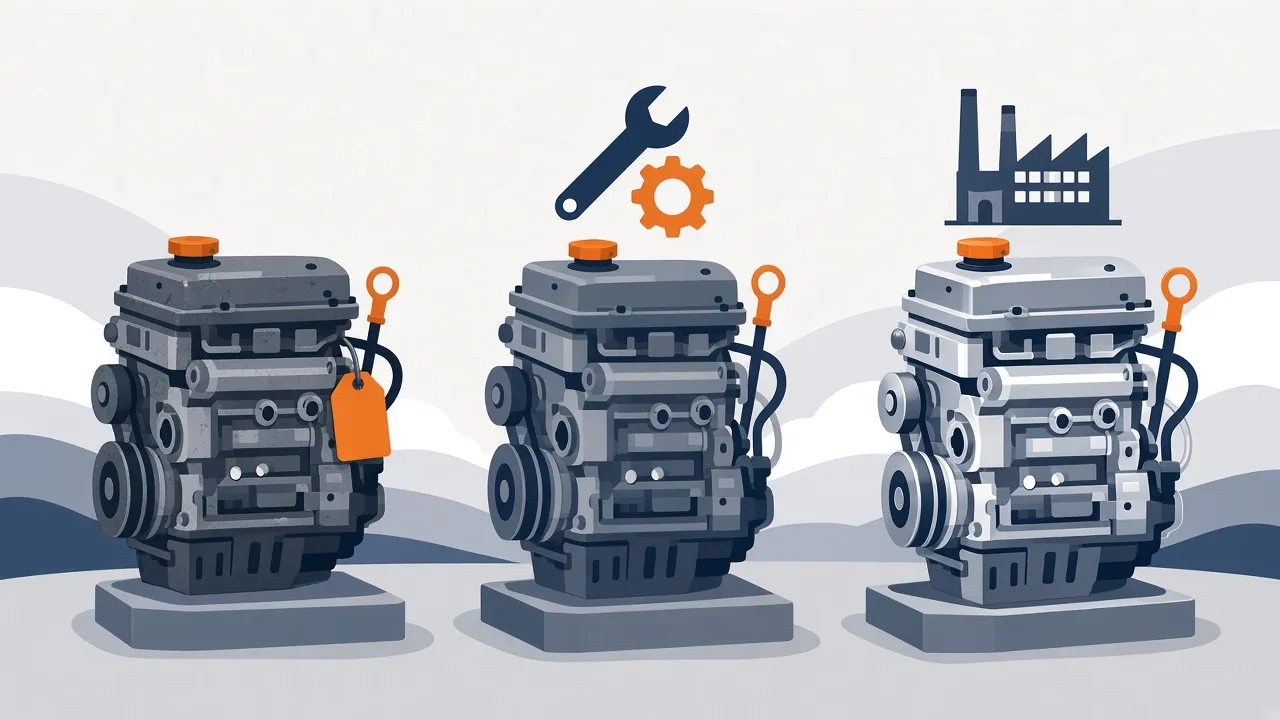
An engine replacement is one of these:
- A new, rebuilt, remanufactured or used engine of the same make, number of cylinders, and engine family (test group) as the original engine, with the original emission controls reinstalled; or
- An engine that matches a configuration the manufacturer offered for that year, make and model, with the appropriate emission controls for that engine and chassis components present and connected.
An engine change is installing an engine that is different from the original and doesn't qualify as a replacement.
Why it matters: according to BAR, engine replacements are not required to be inspected at a BAR Referee. Engine changes are. All vehicles with an engine change must pass an initial inspection at a Referee Center and have a BAR Referee label put inside the engine compartment.
So if your Camry's original 2.5L four-cylinder is worn out and you install a used 2.5L from the same engine family, with the original emissions equipment in place, you're doing a replacement. If you put a V8 from a different vehicle into a truck that came with a V6, that is an engine change.
How to tell if your engine is the same "engine family"
Look at the Vehicle Emission Control Information (VECI) label under the hood. It lists the engine family or test group and whether the vehicle is certified to California or federal standards. Compare it with the donor engine's details. A used-engine seller should be able to tell you the donor vehicle's year, model and engine code; listings that include the VIN engine code (for example, this 2023 Toyota Camry 2.5L listing shows the VIN code and A25A engine designation) make that comparison easier.
The rules for engine changes in California
If your project is an engine change, the BAR/CARB Engine Change Guidelines (Appendix D of the Smog Check Reference Guide) set out the requirements. They're based on California anti-tampering laws, including Vehicle Code Section 27156 and Title 16, Section 3362.1 of the California Code of Regulations, which prohibit engine changes that degrade the vehicle's emission control system.
Here are the core requirements that apply to all model-year vehicles (gasoline, diesel, hybrid and others):
1. Model year: same or newer
The installed engine must be the same model year or newer than the vehicle it's going into. A 2010 engine can go into a 2005 truck (if everything else checks out); a 2005 engine can't go into a 2010 truck.
2. Same vehicle and engine classification (GVWR)
The donor and recipient vehicles must have the same classification based on Gross Vehicle Weight Rating, such as passenger car, light-duty truck or medium-duty vehicle. The guidelines give an example: a heavy-duty truck engine may not go into a light-duty truck, even if displacement is the same.
The guidelines also say non-emissions-controlled engines, such as industrial and off-road-only engines, and non-certified "crate engines," may not be installed in any emission-controlled vehicle.
3. California vs. federal certification
The engine's certification type (California or federal) must match the vehicle's, or the engine must meet the more stringent standard. A California-certified engine can go into a federal vehicle, but a federal engine cannot go into a California vehicle. You must bring proof of the donor engine's certification type (from the manufacturer or a CARB Executive Order) to the Referee inspection.
This is where many out-of-state engine purchases go wrong. Ask the seller about the donor vehicle's emissions certification, and match it against your VECI label. Some listings call out market or emissions variants. For example, this 2019 Subaru Legacy engine listing notes "Canada market, PZEV." If a listing doesn't say, ask.
4. Smog Check tests based on the donor vehicle
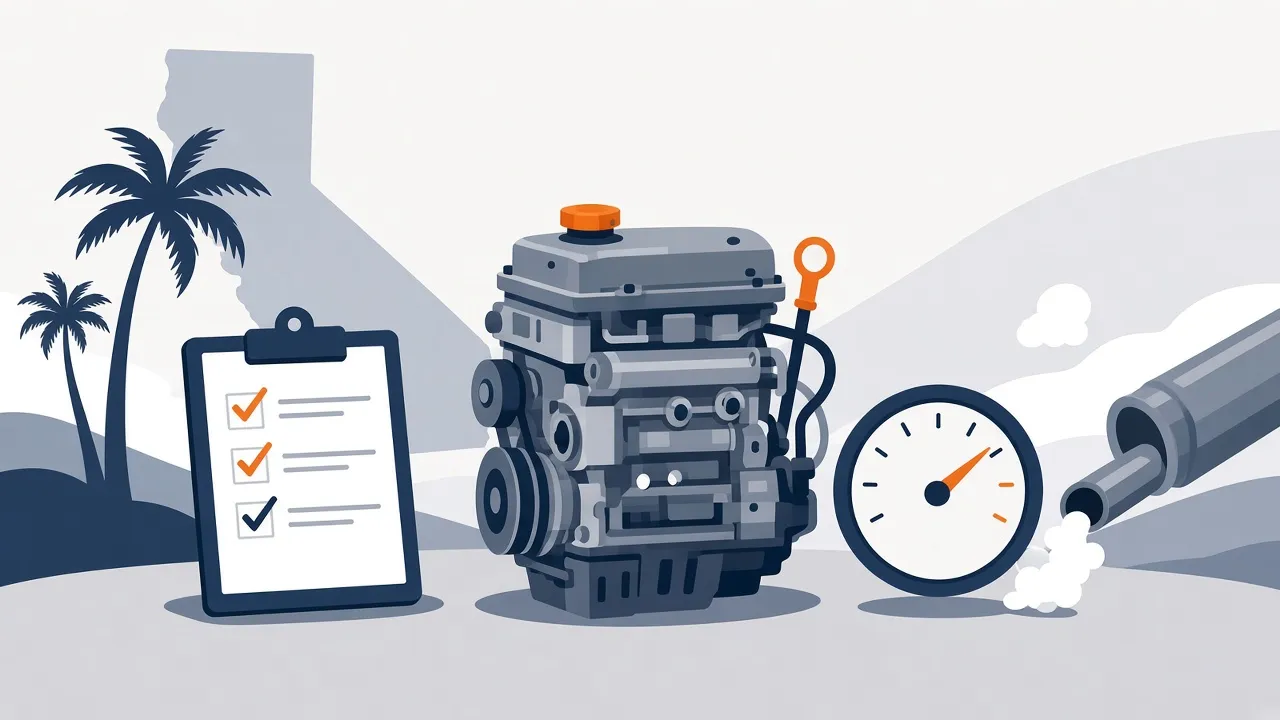
The vehicle must pass the Smog Check tests using the donor vehicle's test requirements, regardless of model year. Depending on the vehicle, that can include a tailpipe test, an OBD II test when an OBD II engine is installed, a check engine light (MIL) bulb check and full OBD function, a visual inspection of all emissions controls, functional tests such as ignition timing, EGR and fuel evaporative tests where applicable, a visible smoke test, and a liquid fuel leak check.
5. Exhaust after-treatment in the right place
Every after-treatment device the donor vehicle was certified with (catalytic converters, diesel particulate filters, oxidation catalysts, SCR) must be present and positioned in the same linear position in the exhaust stream. The guidelines allow:
- Within 6 inches for the close-coupled device nearest the engine (and no closer than stock)
- Within 12 inches of stock for other devices, such as the rear catalyst or DPF
Changes downstream of the last emissions device (such as muffler location) are allowed.
6. Exhaust sensors
Oxygen and other after-treatment sensors must be within 1 inch of their original location relative to their device, with properly welded bungs and the same orientation in the exhaust stream.
7. OBD II must work fully
For an OBD II donor engine, the vehicle must support all of the donor's OBD II functions, including:
- Calibration ID (CalID) and Calibration Verification Number (CVN) matching a certified configuration for the donor engine
- All supported readiness monitors set to "ready," and able to clear and reset properly
- An accessible, working diagnostic link connector (labeled "ENGINE DLC" if there's more than one), with nothing plugged in at inspection
- All required sensors, switches and wiring connected, and a working, labeled check engine light on the instrument cluster
8. Every emissions system from the donor
All emissions systems from the donor vehicle, including evaporative system components such as the canister, plumbing and valves, must be installed and working. For vehicles originally built with OBD II, all emission system configurations must match the donor vehicle, including the transmission, evaporative system, exhaust and intake.
9. Aftermarket parts need approval
Any non-OEM or aftermarket parts on the engine or vehicle must comply with BAR's aftermarket parts rules. CARB keeps a database of approved parts with Executive Orders.
Special cases
- Older (non-OBD II) vehicles getting an OBD II engine: the guidelines let the original transmission and evaporative system stay, as long as they integrate with the engine's OBD II monitoring. OBD II generally applies to 1996-and-newer gasoline and 1998-and-newer diesel vehicles; your VECI label will say if your vehicle is OBD II certified.
- Full electric conversions: treated differently. The fuel system must be completely removed and no fuel-fired heater installed.
- CARB-exempted engine packages: some engine packages have CARB Executive Orders for specific vehicles. They must only be installed in the applications listed in the Executive Order.
Engine change checklist for California
| Requirement | Check | Done |
|---|---|---|
| Replacement or change? | Same make, cylinder count and engine family as original, or a factory-offered configuration? If yes, likely a replacement | ☐ |
| Model year | Engine is same year or newer than the vehicle | ☐ |
| Classification | Donor and recipient share the same GVWR class | ☐ |
| Certification | Engine is California-certified if the vehicle is; proof in hand | ☐ |
| Donor VIN | Have it ready for the Referee appointment | ☐ |
| Emissions parts | All donor emissions systems installed and working | ☐ |
| Catalysts and sensors | Within the 6"/12"/1" position tolerances | ☐ |
| OBD II | CalID/CVN match; readiness monitors complete; MIL works | ☐ |
| Aftermarket parts | Covered by CARB Executive Orders | ☐ |
| Referee appointment | Booked after the vehicle is fully ready | ☐ |
What the Referee inspection looks like
- Booking: BAR says you can make an appointment with the Referee at (800) 622-7733. BAR's FAQ also points to asktheref.org for scheduling.
- Bring the donor VIN. BAR notes that having the donor vehicle's VIN at the first appointment simplifies the process. Also bring proof of the engine's certification and your installation paperwork.
- The first inspection is based on the donor vehicle's Smog Check requirements.
- After you pass: the Referee label is put inside the engine compartment. Future Smog Checks can be done at a regular Smog Check station, based on that label.
- Frequency doesn't change. BAR says Smog Check frequency requirements stay the same after an engine change.
Get readiness monitors complete before you go. Some monitors need specific drive cycles to finish, and the guidelines note that owners may need help from a dealer or shop with the right tools.
The simplest path: replace like with like
BAR's own recommendation is to rebuild and reinstall the original engine, transmission and emissions configuration, use a California-certified engine, or use a CARB-exempted engine package. For most daily drivers, the easiest approach is a replacement with the same engine family your vehicle shipped with, which avoids the Referee requirement.
When shopping for that kind of replacement:
- Match the VIN engine code to your original. Model pages such as used Toyota Corolla engines, used Honda Civic engines and used Ford F-150 engines break listings out by year and engine option.
- Confirm certification against your VECI label.
- Reinstall all original emissions equipment and fix whatever caused the old engine to fail.
- Read the warranty terms. For example, State Auto Parts' warranty covers the core engine and internal parts for two years from delivery, requires installation within 10 business days of delivery and installation by a qualified technician, and excludes labor and bolt-on items such as sensors and wiring.
Delivery in California
State Auto Parts is based in Torrance, California. Its shipping policy lists free shipping to commercial addresses within the continental 48 states, a $250 fee for residential delivery, and a typical delivery window of 3-5 business days after processing (varying by part location and carrier). Having the engine delivered to the shop doing the installation is usually the simplest option.
Planning a California engine replacement?
Start with your VIN and VECI label, then find a matching engine. Browse used engines by vehicle, or call a State Auto Parts specialist at (800) 241-8053 to confirm the engine code before you order. For more help choosing, see used vs rebuilt vs remanufactured engines and what to look for when buying a used engine. If your transmission needs replacing too, see how to check a used transmission before you buy.