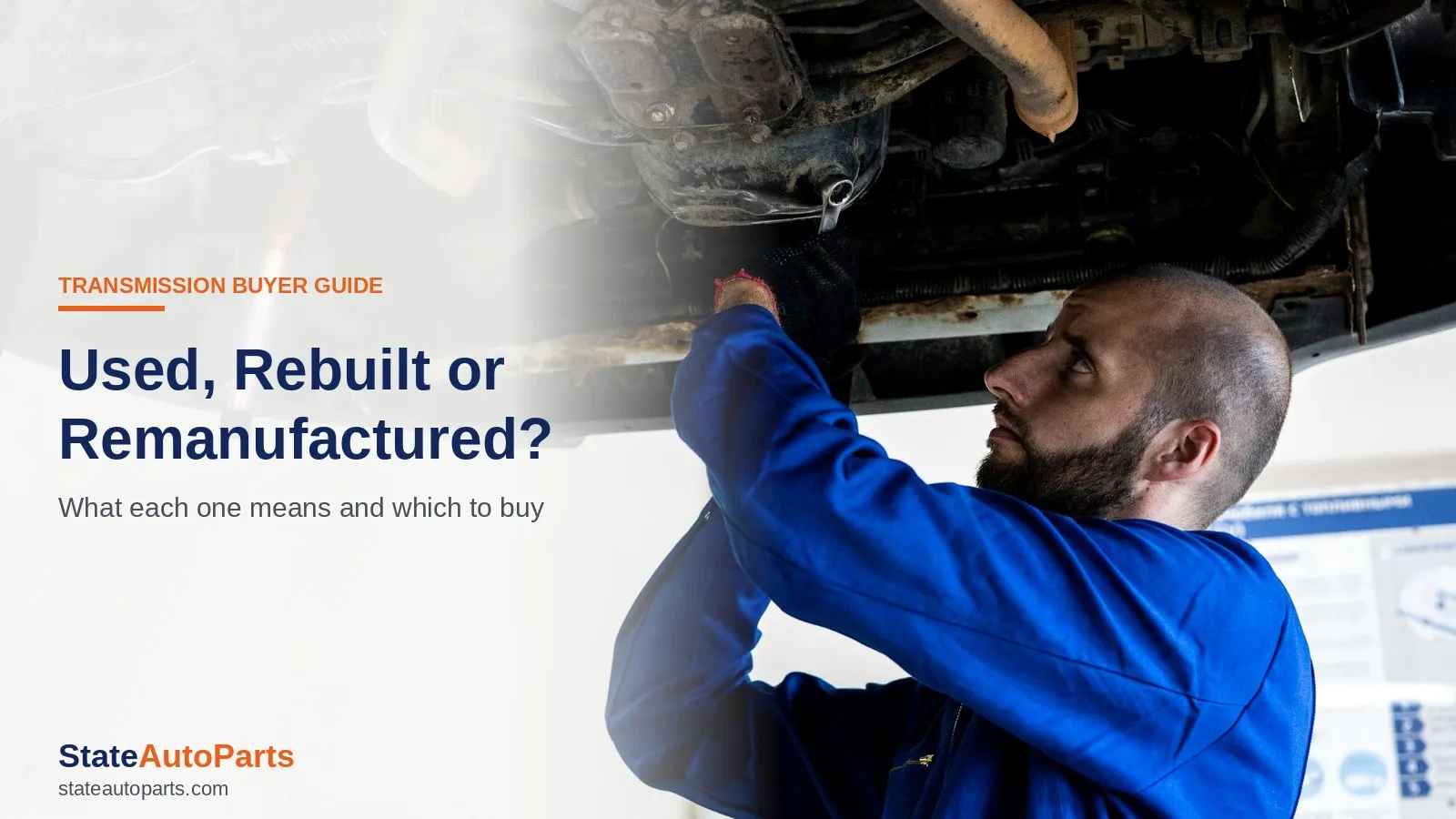
When a transmission quits, the shop usually gives you three ways out: put in a used unit, rebuild the one you have, or buy a remanufactured transmission. The three words get thrown around loosely, and two quotes that sound alike can describe very different jobs. This guide explains what each term actually means, what you get for the money, and how to pick the right one for your vehicle and budget.
If you're still not sure the transmission is the problem, start with our guide to the signs of a bad transmission. A failed sensor, a wiring fault or low fluid can look like a dead transmission, and none of them need a replacement.
The short answer
- Used is the lowest-cost way to get a working transmission back in the car. It's a factory-built unit pulled from a donor vehicle, not taken apart. It makes the most sense when you can get a tested, low-mileage unit with a real warranty.
- Rebuilt means a transmission (often your own) was taken apart, cleaned, and had its worn and damaged parts replaced. Quality depends almost entirely on the shop and the builder.
- Remanufactured is a rebuild done in a factory that does this work as its main business, usually with standard procedures and testing on a machine before the unit ships. It's usually the most expensive of the three.
None of them is "best" for everyone. The right pick depends on what your car is worth, how long you plan to keep it, how common your transmission is, and how much downtime you can live with.
What the words mean under federal guidelines
The Federal Trade Commission has guides for used auto parts in 16 CFR Part 20, and they list transmissions and transaxles by name. Under section 20.3:
- A part should only be called rebuilt if, since it was last used, it was taken apart as needed, all of its parts were cleaned and made free of rust and corrosion, worn or damaged parts were restored or replaced, missing parts were replaced, and any machining needed to put it in sound working condition was done.
- A part should only be called remanufactured or factory rebuilt if it was rebuilt to that same standard at a factory generally engaged in rebuilding those products.
So, legally, the difference between rebuilt and remanufactured is mostly where the work happens, not a secret extra step. In practice, factory remanufacturers tend to work from fixed procedures, replace known weak parts with updated ones, and test every unit. Local rebuilders range from excellent to poor.
A used transmission is none of the above. The FTC guides expect sellers not to pass used parts off as new or rebuilt. A good used unit is simply an original transmission that worked in its donor vehicle and was checked before it was sold.
The Automatic Transmission Rebuilders Association (ATRA) adds a useful point in its overview of transmission repair options: brand-new transmissions generally aren't sold for repair, and what dealers sell as a "new" replacement is usually a remanufactured unit. Words like refurbished, reconditioned and overhauled are generally used to mean a rebuild.
Side-by-side comparison
| Used | Rebuilt | Remanufactured | |
|---|---|---|---|
| What it is | Original unit from a donor vehicle | Your unit or a core, torn down and repaired by a shop | Unit rebuilt in a factory that specializes in it |
| Taken apart? | No | Yes | Yes |
| Wear parts replaced | No | Usually clutches, seals, gaskets, plus damaged parts | All wear parts, often with updated designs |
| Testing | Varies by seller | Varies by shop, often a road test | Usually tested on a machine before shipping |
| Price | Usually the lowest | Middle, depends on damage found | Usually the highest |
| Downtime | Depends on shipping | Your car waits while the unit is rebuilt | Depends on stock and shipping |
| Warranty | Depends on seller | Depends on shop | Usually backed by the remanufacturer |
| Biggest risk | Unknown history of the donor | Builder skill and parts quality | Higher upfront cost |
Prices for all three swing widely by model. A common automatic for a popular truck costs far less than a rare unit for a luxury SUV. For real numbers on used units and labor, see our used transmission replacement cost guide.
A closer look at used transmissions
A used transmission is the factory unit from another vehicle, often one that was totaled in a crash that didn't involve the drivetrain. It's never been opened. That's a plus and a minus: no one has introduced a rebuild mistake, but you also can't see inside.
Why people choose used:
- It's usually the cheapest way to get a working transmission.
- It's an original factory assembly, built to the same specs as yours.
- Common units are easy to find in many mileage ranges.
- There's no waiting while a shop rebuilds your old unit.
What to watch:
- Fitment. Automatics change inside a model year. Match the transmission code, drive type (2WD, 4WD, FWD, AWD) and engine, not just the year. Our listings show these details in the title, for example this 2021 Buick Enclave FWD transmission (ID 1QKB, 53k miles) or a 2017 Lincoln Navigator 6R80 6-speed (4x2, 47k miles).
- Mileage and grade. Lower mileage is better, but mileage on any used part is stated to the seller's best knowledge, not guaranteed. Ask what the grade means and how the unit was checked.
- Warranty. Read it before you buy. Some sellers offer 30 or 90 days, others much longer. At StateAutoParts, our transmissions carry a 2-year limited parts warranty on the case and internal parts when a qualified technician installs the unit within 10 business days and you keep up fluid service.
- Programming. Many modern transmissions need software or adaptive relearns after install. See does a used transmission need to be programmed before you book the job.
One thing many buyers don't realize: don't open a used transmission to "freshen it up" before you install it. Our refund and return policy and warranty both exclude units that have been taken apart or tampered with, and most used-parts sellers work the same way. If you want a rebuild, buy a rebuild.
Our used transmission checklist walks through what to check on delivery day.
A closer look at rebuilt transmissions
A rebuild usually means a transmission shop pulls your unit, takes it apart, and decides what to replace. A typical overhaul replaces clutches, bands, seals, gaskets and filters (the "soft parts") and any damaged hard parts, such as drums, gears, shafts, bushings or the valve body. Many shops also replace or rebuild the torque converter.
Why people choose a rebuild:
- You keep your own transmission, which already fits your car and is already coded to it.
- A good builder can fix known weak spots for your model.
- If the damage is light, the parts bill can be reasonable.
What to watch:
- The price can move. A rebuild quote is often an estimate until the unit is torn down. Hard-part damage, a cracked case or a burned valve body can push the bill up. Ask for a written "not to exceed" number or a call before extra work.
- Builder quality. The FTC definition sets a minimum. It doesn't guarantee the person doing the work is good. Ask how many units of your type the shop rebuilds, whether it replaces the torque converter, whether it updates the valve body, and whether it cleans or replaces the cooler.
- Downtime. Your car is usually off the road while the unit is out, rebuilt and reinstalled.
- Warranty reach. Many shop warranties only cover work done at that shop. ATRA member shops can offer its Golden Rule warranty program, according to ATRA, so it's worth asking whether your shop is a member and what the warranty covers if you move or break down on a trip.
A rebuild can be a great choice for a vehicle you plan to keep, especially if you have a trusted transmission shop nearby. It's a poor choice if the shop can't tell you what it will replace.
A closer look at remanufactured transmissions
Remanufactured units are built in a factory that rebuilds the same transmission families over and over. A remanufacturer usually takes in cores, takes them apart, cleans and measures the parts, replaces every wear item, applies its own updates, and tests the finished unit before it ships.
Why people choose reman:
- The most consistent process of the three, with known updates built in.
- Usually the longest and most portable warranty, backed by the remanufacturer.
- The best fit when your own unit has major internal damage.
What to watch:
- Cost. It's usually the most expensive option, sometimes by enough to exceed what an older car is worth.
- Core charge. Most reman units are sold with a core deposit that you get back when you return your old transmission in acceptable condition. Read the core rules before you sign.
- Availability. Reman units for less common or older transmissions can be hard to find or back-ordered.
- "Reman" in name only. Ask who remanufactured the unit and get the warranty from that company in writing.
Labor is the same no matter which unit you buy
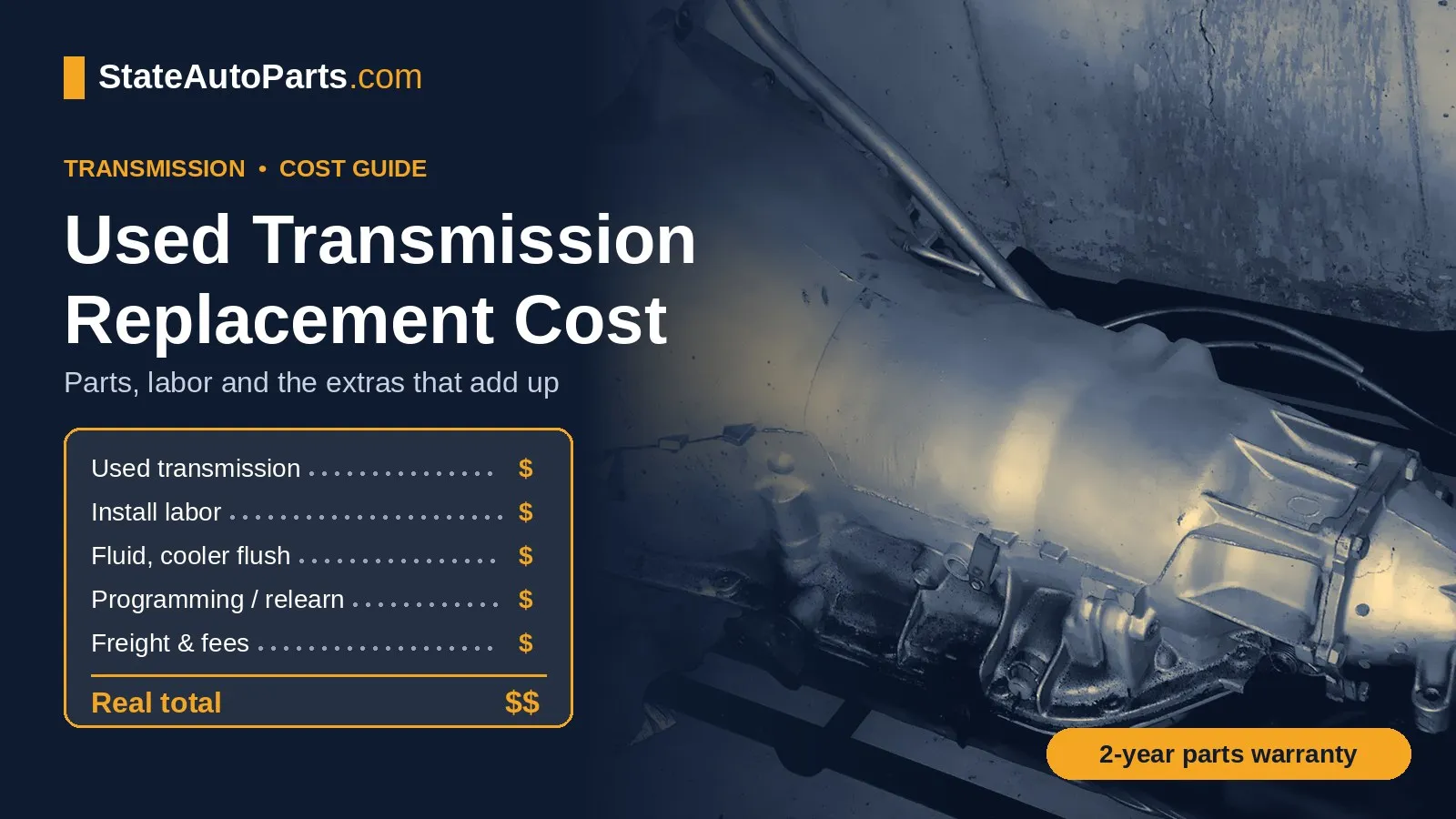
This is the part that changes the math. Removing and installing a transmission costs about the same whether the unit going in is used, rebuilt or remanufactured. Fluid, a cooler flush, mounts and programming get added on top of all three.
That means a cheap unit that fails early can cost you that labor twice. It also means the true comparison is never "used price vs reman price." It's the total installed cost plus the warranty you get back if it goes wrong. When you compare quotes, write down:
- The unit price, including core charges or deposits.
- Shipping or delivery, including residential fees.
- Installation labor and extras (fluid, cooler flush, programming).
- Warranty length, what it covers, and whether it pays labor.
- How long the car will be off the road.
At StateAutoParts, shipping is free to commercial addresses in the lower 48 (a repair shop counts), residential delivery adds a $250 fee, and there's no core deposit or core return required. Our warranty covers parts, not labor, so factor that in the same way you would for any seller.
Which one should you choose?
Use these situations as a starting point, then check real quotes.
| Your situation | Usually the best fit |
|---|---|
| Older, lower-value car you want running at the lowest cost | Used, with a solid warranty |
| Popular truck or SUV with plenty of low-mileage donors | Used, matched by code and drive type |
| You'll keep the car for years and have a trusted transmission shop | Rebuilt |
| Known problem transmission and the shop has update kits for it | Rebuilt or remanufactured |
| Major internal damage, a cracked case or metal throughout the old unit | Remanufactured or a good used unit, not a rebuild of your old one |
| You can't have the car off the road for long | Used or a remanufactured unit in stock |
| Rare or discontinued transmission | Used, or a rebuild of your own unit |
A few more rules of thumb:
- If the vehicle's value is low, the cheapest option with a real warranty usually wins. Spending reman money on a car worth less than the repair rarely makes sense.
- If the failure was caused by something else, such as an overheating cooler, a leak or a bad engine, fix that first. No replacement survives the same problem.
- If you tow or haul, ask about updates for heavy use and favor the option with the strongest warranty.
Real examples from our inventory
To show what a used option looks like, here are a few in-stock Grade A units from our catalog as of October 2026. Prices change, so check the listing for today's price.
| Vehicle | Unit | Mileage | Listed price |
|---|---|---|---|
| 2023 Ford F-150 5.0L | Automatic | 52k | $3,643 |
| 2023 Ford Explorer 3.3L police package | Automatic, non-hybrid | 40k | $2,306 |
| 2021 Buick Enclave FWD | Automatic, ID 1QKB | 53k | $2,074 |
| 2017 Lincoln Navigator 4x2 | 6R80 6-speed | 47k | $1,597 |
You can browse more by make, such as used Ford transmissions, Buick Enclave transmissions and Lincoln Navigator transmissions, or search all used transmissions by year, make and model.
Questions to ask before you pay
Whichever way you go, get answers to these in writing:
- Exactly what is being installed? Used, rebuilt or remanufactured, and by whom.
- Does it match my vehicle? Transmission code or tag, engine, drive type and build date.
- What's included? Torque converter, valve body, solenoids, cooler lines, fluid.
- What does the warranty cover? Parts only or parts and labor, for how long, and what voids it.
- What do I have to do? Install deadline, required fluid, maintenance records.
- What happens if it fails? Who diagnoses it, who pays freight, and how long a replacement takes.
- Is there a core charge or deposit? And what condition the old unit must be in.
The same thinking applies to engines. If you're comparing engine options too, see our guide to used vs rebuilt vs remanufactured engines.
Bottom line
A used transmission is an original factory unit at the lowest price, and it's a smart buy when it's matched correctly and backed by a real warranty. A rebuild can be excellent in the hands of a skilled local shop, but its quality and final price depend on the builder. A remanufactured unit costs the most and gives you the most consistent process. Compare the total installed cost and the warranty, not just the sticker price, and fix whatever caused the first failure before the new unit goes in.
If you'd like help matching a used transmission to your VIN, call our team at (800) 241-8053.