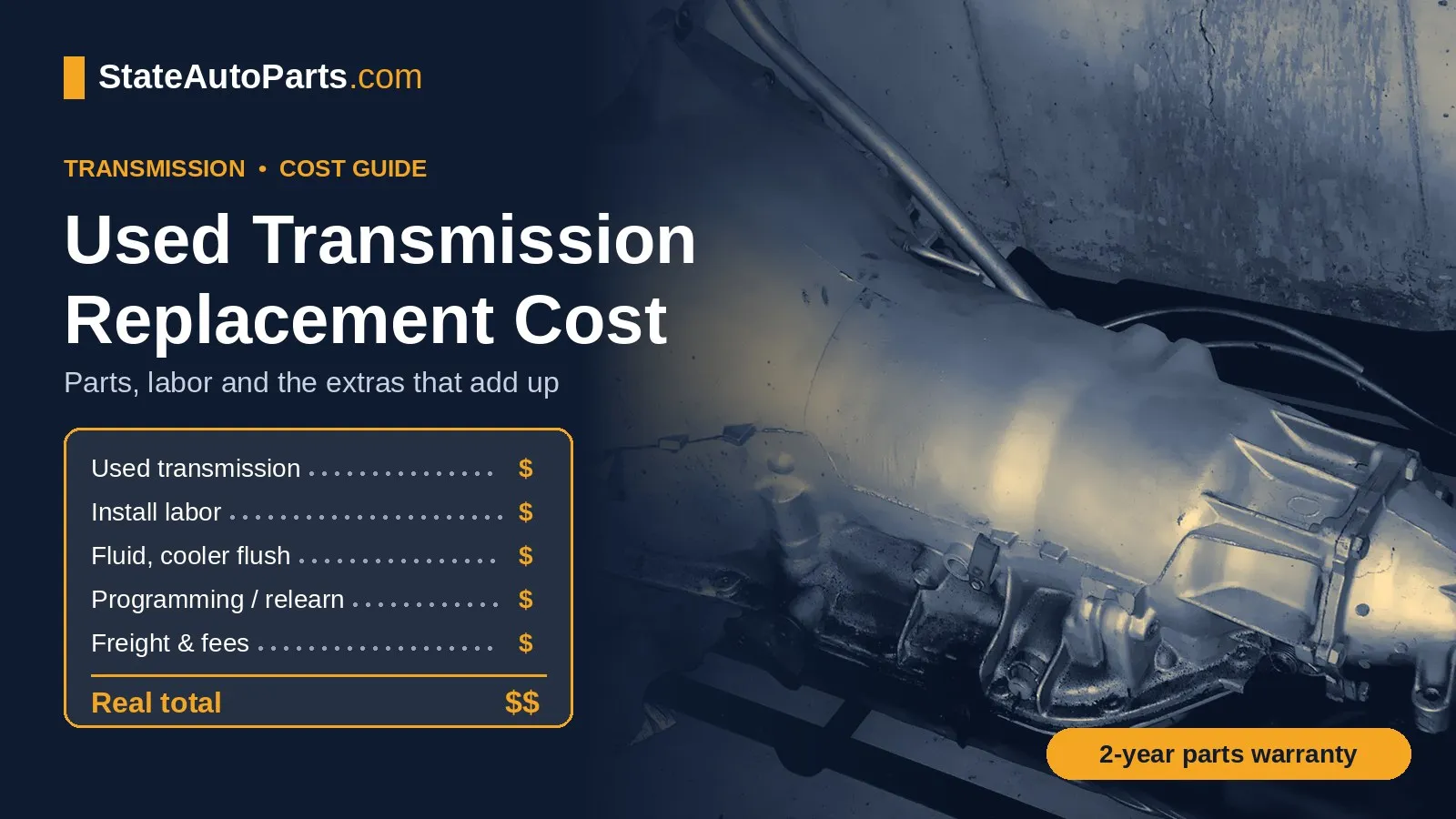
When a transmission fails, the first number most people look up is the price of a replacement unit. That's only one line on the bill. Labor, fluid, cooler work, programming, delivery and shop fees all land on the final invoice, and they can add up to more than the transmission itself on an inexpensive car.
This guide breaks a used transmission replacement into its real cost pieces, shows where each number comes from, and walks through worked examples built from real State Auto Parts listings. Prices change daily and every vehicle is different, so use these ranges to plan and to check a shop's quote, not as a quote themselves.
The Short Answer
A used transmission replacement costs the price of the transmission plus the shop's labor plus fluid, any cooler or programming work, delivery, fees and tax. Two numbers drive most of it:
- The transmission. Across 18,641 priced salvage-yard listings covering 43 models, Part Price Guide found a national median of $1,254 for a used transmission and an average of $1,495. Model medians ran from $428 to $3,300 (Part Price Guide).
- Labor. Shop estimates commonly put a transmission swap at roughly 4 to 12 hours, depending on the vehicle and drivetrain (Earl). AAA reports that almost half of U.S. shops charge $120 to $159 an hour (AAA).
Multiply those and labor alone at a typical shop works out to about $480 (4 hours at $120) to $1,908 (12 hours at $159). Part Price Guide's own estimate for a swap is $500 to $1,500 in labor. Shops with higher rates, or vehicles that need the subframe dropped, will cost more.
For comparison, RepairPal puts the average new or remanufactured transmission replacement at $6,238 to $6,764, with labor alone at $1,127 to $1,654 (RepairPal). That gap is the main reason people choose a used unit.
Cost 1: The Transmission Itself
The transmission is usually the biggest line, and it swings more than any other.
What moves the price
- Vehicle and drivetrain. Truck and full-size SUV transmissions cost more than compact-car units. A 4x4 or AWD version can differ from the 2WD unit in the same model.
- Transmission type. Conventional automatics, CVTs, dual-clutch units and manuals are priced differently, and they aren't interchangeable.
- Model year and mileage. Late-model, lower-mile units cost more. They also tend to have more life left.
- Condition grade. In Part Price Guide's data, Grade A units had a $1,298 median, Grade B $1,136 and Grade C $750.
- Testing and warranty. A tested unit with a long written warranty usually costs more than an untested pull with 30 days of coverage. Part Price Guide says used transmission warranties typically run 30 to 90 days, so a longer warranty is worth part of the price difference.
Salvage-yard medians by model
These medians come from Part Price Guide's August 2026 analysis of salvage-yard asking prices. They mix all model years, mileages and grades, so treat them as a sense of scale.
| Vehicle | Median used transmission price | Priced listings |
|---|---|---|
| Nissan Sentra | $428 | Not stated |
| Honda CR-V | $748 | 600 |
| Honda Civic | $923 | 538 |
| Hyundai Elantra | $1,254 | 634 |
| Ford F-150 | $2,075 | 1,293 |
| GMC Sierra 1500 | $2,509 | 927 |
| Chevy Tahoe | $2,700 | 1,260 |
| Toyota Camry | $3,275 | Not stated |
Source: Part Price Guide, used transmission cost analysis. Asking prices only, without shipping, core charges, tax or labor.
Real listings from late-model donors
Late-model, lower-mile transmissions sit above those all-years medians. Here's what a few State Auto Parts listings showed when this guide was written (October 2026). Each product page shows a price range based on condition and grade.
- A 2022 Toyota Camry 2.5L AWD used transmission listed at 45k-52k miles, Grade A was listed at $2,360 to $2,596.
- A 2023 Hyundai Elantra 7-speed dual-clutch used transmission listed at 39k-45k miles, Grade A was listed at $2,600 to $2,860.
- A 2022 Chevy Silverado 1500 3.0L 4x2 used transmission listed at 47k-54k miles, Grade A was listed at $3,073 to $3,380.
- A 2023 Honda CR-V 1.5L turbo AWD used transmission listed at 52k-60k miles, Grade A was listed at $3,422 to $3,764.
- A 2023 Ford F-150 5.0L 4x4 used transmission listed at 52k-60k miles, Grade A was listed at $3,643 to $4,007.
Notice the CR-V. Its all-years median is $748, but a 2023 AWD unit with about 50,000 miles costs several times that. Always price the exact year, engine and drivetrain your VIN calls for. You can browse by make and model from the used transmissions catalog, and our guide on how to check a used transmission before you buy covers matching the unit to your vehicle.
Cost 2: Labor
Most shops bill a transmission swap by "book time": a published labor time for your vehicle, multiplied by the shop's hourly rate, no matter how long the job really takes (AAA).
How many hours
Earl's summary of published estimates says shops commonly quote 6 to 12 hours, with AutoZone putting a manual swap at about 4 to 6 hours and an automatic at about 6 to 10 (Earl). The hours climb when:
- The vehicle is front-wheel drive or AWD with a transverse engine, where the axles, subframe or engine mounts have to come out
- The vehicle has a transfer case (4x4 and many AWD systems)
- Bolts are rusted or seized, which is common in salt-belt states
- RepairPal notes that some vehicles need the subframe or even the engine removed to get the transmission out
What labor costs at typical rates
| Book time | At $120/hr | At $159/hr |
|---|---|---|
| 4 hours | $480 | $636 |
| 6 hours | $720 | $954 |
| 8 hours | $960 | $1,272 |
| 10 hours | $1,200 | $1,590 |
| 12 hours | $1,440 | $1,908 |
Hourly band: AAA, citing the 2025 PartsTech shop survey. Some shops charge under $100 an hour and some over $200.
Ask your shop for its book time and rate before you order. That one number tells you more about the final bill than any national average.
Cost 3: Fluid, Cooler Flush and Programming
These are the lines that surprise people most, and they matter for whether the replacement lasts.
- Fluid. A replacement transmission needs a full fill of the correct fluid. Kelley Blue Book puts a transmission fluid flush at about $165 to $290 as a standalone service (Kelley Blue Book). The fluid for a swap is usually billed as a parts line on the same invoice.
- Cooler flush or new cooler. If the old transmission failed internally, metal and clutch debris can sit in the cooler and lines. If that debris isn't flushed out, it goes straight into the replacement unit (Gearbox Insider). Expect a flush or, on some vehicles, a new cooler.
- Programming or relearn. Many modern automatics need the transmission control module programmed or an adaptive relearn after a swap. Our guide on whether a used transmission needs to be programmed explains when this applies and who can do it.
- Mounts and seals. A worn transmission mount, a leaking axle seal or a cracked cooler line is cheapest to replace while everything is apart.
Cost 4: Delivery, Core Charges and Fees
These vary by seller, so compare them before you compare sticker prices.
- Shipping. Transmissions weigh roughly 100 to 400 pounds, and Part Price Guide says online sellers typically charge $150 to $400 to ship one. State Auto Parts delivers free to commercial addresses in the lower 48 states and charges $250 for residential delivery. Liftgate service is free on request, and Alaska, Hawaii and Puerto Rico need a freight quote. Details are on the shipping policy page.
- Core charge. Many yards hold a refundable deposit until you return your old unit. State Auto Parts doesn't charge a core deposit, and you don't need to send the old transmission back.
- Shop fees and disposal. Many shops add a supplies or environmental fee and charge to dispose of the old unit and fluid.
- Tax. Sales tax on the part, and on labor in some states.
Cost 5: The Cost of Getting It Wrong
Two mistakes can double the bill.
- Ordering the wrong unit. If it doesn't fit, you pay freight again and usually a restocking fee. The State Auto Parts return policy requires prior written authorization within 30 days, charges a 25% handling fee on returns and cancellations, and doesn't reimburse labor or towing. Confirm the match with your VIN before you order.
- Replacing a transmission that wasn't the problem. Shifting problems can come from low fluid, a bad sensor, wiring or a software issue. RepairPal recommends a proper diagnosis before any replacement. Our guide on signs of a bad transmission and whether to repair, rebuild or replace walks through the symptoms.
There's also labor risk. If a cheap used unit fails, you pay to install the next one too, and most used-part warranties don't cover labor (Gearbox Insider). That's why the warranty length and the testing behind the unit matter as much as the price.
Worked Examples
These examples add the October 2026 State Auto Parts listing range to the full $480 to $1,908 labor band from the table above. They assume delivery to a repair shop (a commercial address, so no delivery fee). Fluid, cooler work, programming, fees and tax are not included.
| Vehicle | Transmission listing | Labor band | Part + labor |
|---|---|---|---|
| 2022 Toyota Camry 2.5L AWD | $2,360 - $2,596 | $480 - $1,908 | $2,840 - $4,504 |
| 2023 Hyundai Elantra DCT | $2,600 - $2,860 | $480 - $1,908 | $3,080 - $4,768 |
| 2022 Chevy Silverado 1500 3.0L 4x2 | $3,073 - $3,380 | $480 - $1,908 | $3,553 - $5,288 |
| 2023 Honda CR-V 1.5T AWD | $3,422 - $3,764 | $480 - $1,908 | $3,902 - $5,672 |
| 2023 Ford F-150 5.0L 4x4 | $3,643 - $4,007 | $480 - $1,908 | $4,123 - $5,915 |
The labor band is deliberately wide. A 4x4 truck or AWD crossover will usually sit in the upper half, and your shop's book time narrows it to one number.
Used vs Rebuilt vs Remanufactured: Where the Money Goes
Part Price Guide's comparison puts a rebuild at about $1,800 to $3,500 with a 3 to 10 day turnaround and a 1 to 3 year warranty, a remanufactured unit at about $2,500 to $5,000 with warranties from 3 years to lifetime, and a new OEM transmission at $3,500 to $8,000 or more. It estimates that a used unit saves $500 to $2,000 compared with a rebuild. Kelley Blue Book notes that brand-new transmissions are mostly reserved for new cars, so most owners are really choosing between used, rebuilt and remanufactured.
A used transmission makes the most sense when:
- The vehicle is worth keeping but not worth a $6,000 repair
- You can get a late-model, lower-mile unit that matches your VIN
- The seller tests the unit and backs it with a real written warranty
The State Auto Parts 2-year limited parts warranty covers the transmission's internal mechanical parts. It doesn't cover labor, bolt-on parts, sensors or wiring, and the unit must be installed by a qualified technician within 10 business days of delivery.
How to Get an Accurate Quote
Before you order, get this from your shop in writing:
- The book labor time for your exact vehicle and drivetrain
- Their hourly rate
- Fluid type and quantity, and whether they'll flush or replace the cooler
- Whether the vehicle needs programming or a relearn, and whether they can do it in-house
- Any mounts, seals or lines they recommend replacing
- Shop fees, disposal and tax
- When they can install it
That last question matters because the warranty clock for installation starts at delivery. Don't schedule delivery until the shop has a bay ready.
From the seller, get the exact match to your VIN, the donor mileage, the grade, delivery cost to your shop and the written warranty terms.
Bottom Line
A used transmission replacement is the price of the unit plus about 4 to 12 hours of labor, with fluid, cooler work, programming, delivery and fees on top. Published data puts the median salvage-yard transmission at $1,254, but late-model, low-mile units cost more, and labor at typical shop rates adds roughly $480 to $1,908. Get your shop's book time and rate first, price the exact unit your VIN calls for, and add every line before you order.